
none
Engagement
Deliverability
Emails
Engagement
Deliverability & Email Chaos Theory: Authentication Protocols “Your Emails’ Identity Crisis”
June 9, 2026
Series Edition: Section 2 - Authentication Protocols “Your Emails' Identity Crisis”
Your Emails Need an ID Card
SPF, DKIM, DMARC Explained (Without the Jargon)
Here’s an example: You write the ideal email. It has everything. You have a good copy and good design. You send it to 50,000 recipients. Gmail blocks your email.
Why?
Because you didn’t verify your identity.
This is called authentication, and you must do it.
The Trust Problem
These days, ISPs (Internet Service Providers: Gmail, Yahoo, Outlook, et al.) do not trust anything by default. The first thing they want to ask about an incoming email is whether it is legitimate and whether it really came from whoever the sender claims to be.
And why do they do that? Because spammers are sneaky. They use fake domain names, masquerade as your bank, clone organizations, and send you emails which are supposedly sent "from: [email protected]," whereas they were sent from some shady server located in Russia.
To establish authenticity, ISPs designed a special mechanism that we refer to as an email's ID card and authentication protocols!
But here's how things are different: In February 2024, just two years ago, Gmail and Yahoo implemented this rule. If you're not authenticated, and you're trying to send 5,000 emails per day, they will not be accepted or moved to the junk folder without any consideration for the content. You'll be rejected. And today, in 2026, there are even more severe measures in place. There are no temporary warnings from ISPs anymore. Your emails get immediately rejected.
So if you haven't set this up yet, you have a serious problem right now.
The Three Protocols
There are three authentication systems. They work together like a security team. SPF is your basic ID check. DKIM is your certified signature. DMARC is the enforcement layer.
Protocol |
What It Does |
Power Level |
SPF |
Lists which servers can send from your domain |
Basic |
DKIM |
Digitally signs your email (like a wax seal) |
Medium |
DMARC |
Combines SPF+DKIM and tells ISPs what to do if they fail |
Advanced (THE BOSS) |
SPF: The Clipboard
SPF stands for Sender Policy Framework. Here's the simple version: SPF is a whitelist.
You make a list of the servers that are allowed to send emails using your domain name. The email will be passed by Gmail if the email comes from any of those servers. Otherwise, the email will fail.
Imagine a bouncer with a list at the entrance of a nightclub. "Names on the list, come in. Not on the list? Then you can stay outside!"
Now here’s the downside: SPF checks the source only. However, a smart attacker can spoof an email if they know the right server. Yet it is crucial. Every domain need SPF.
DKIM: The Wax Seal
DKIM, which stands for DomainKeys Identified Mail, is tougher to spoof than SPF. This involves digitally signing your message, like stamping a wax seal on an envelope.
Here's how it works: Whenever you send an email, DKIM digitally signs it (this is done automatically by your email provider). Once the recipient gets your email, they authenticate this digital signature and ensure two things: (1) that it is genuinely from you, and (2) that it hasn’t been tampered with since sending.
ISPs consider DKIM very important when evaluating emails. If your email has been DKIM-signed, the ISPs give it priority. On the other hand, if it is unsigned, they are suspicious of it.
Good news: Your email provider takes care of DKIM signing automatically.
DMARC: The Boss
DMARC stands for Domain-based Message Authentication, Reporting & Conformance. It's the boss of the group. It combines SPF and DKIM and tells ISPs what to do when something goes wrong.
DMARC has two functions:
1. Enforcement: You inform ISPs about what should happen if an email fails SPF and/or DKIM. Should they reject the email? Quarantine it? Or should they simply monitor it?
2. Visibility: Reports come in that will let you know exactly what's going on in your authentication process.
Here's where you have some serious control and insight.
How They Work Together
SPF checks: Is this coming from an authorized server?
DKIM checks: Is this properly signed digitally?
DMARC policy: If either fails, this is your response.
All three work together to create a castle. Basically, you're saying, "Email security is important to me. IISPs can rely on my emails."
If one of them is missing, there is a vulnerability. The ISPs will take advantage of this by using more filtering.
And it must be monitored. You don’t set it up once and leave it alone.
Why ISPs Got Strict
ISPs are overwhelmed with spam. In fact, approximately 46% of email traffic consists of spam. Thus, ISPs are ruthless when it comes to filtering. And one of the first criteria is authentication.
If your email lacks SPF, DKIM, and DMARC authentication protocols, ISPs will instantly assume that you're a spammer. No "maybe" or "possibly." Assume. Because legitimate businesses always authenticate their messages. Professionals don't send unauthenticated emails. Spammers do.
When Google and Yahoo required authentication two years ago, they weren't being jerks. They were saying, "Look, we are overwhelmed with spam. If you want us to consider looking at your message, show us it isn't a scam."
Why ISPs Became a Bouncer
Approximately 46% of all email that is being sent at this very moment is spam. Yeah, about 46%. That's crazy!
Gmail receives 15 billion unsolicited emails EVERYDAY. Yes, you heard right. 15 BILLION!
That is why they decided to tell everyone that “Nobody can be trusted anymore. Everyone must show ID.”
Having SPF, DKIM and DMARC will mean that you are telling Gmail, “I’m here legally and I take security seriously.” Gmail listens to that.
Not having these three means that Gmail treats you as spam. Since only legitimate businesses authenticate emails.
The Death Spiral (This Is What Actually Happens)
1. You fail authentication -> ISPs won’t recognize you
2. ISPs won’t recognize you -> your emails go through filtering
3. Emails are filtered -> people ignore them -> ISPs see low user activity
4. ISPs see low user activity -> they’ll be stricter with filtering next time
5. You’re on the spam permanently -> nothing goes through anymore
And the worst part about it is that the recovery process is long. We’re talking about weeks or even months. You’re going to be struggling against Gmail and Yahoo to get off the spam blocklist. Your reputation is ruined. And even when you do fix the authentication, Gmail’s not going to trust you anytime soon.
But there’s no need for it at all. This is entirely preventable.
Real Talk
If you’re not positive that SPF, DKIM, and DMARC are configured, chances are good they’re not.
Check it right now. Seriously.
Look up “SPF DKIM DMARC checker,” type in your domain, and you’re done in five minutes. If there’s a problem, send an email to your email service provider ASAP. They’ll get it sorted out.
Not done setting them up. Better get started right now. Don’t wait. Do it today. Gmail and Yahoo aren’t playing games.
What You Need to Remember
Authentication is mandatory. This is true for Gmail and Yahoo, which will enforce it by 2026.
No authentication means automatic fraud. ISPs make no exceptions.
There are serious consequences for making mistakes. Loss of income. Reputational damage. Contractor expenses. Support costs. Loss of elections.
It takes time and money to rebuild your reputation. Preventative measures are less expensive than remedial ones.
You need SPF, DKIM, and DMARC, all three.
Next Section
Authentication is the first hurdle that ISPs put up for your emails. They need to confirm that your emails are authentic before looking at anything else.
But there's a second barrier: sender reputation.
Even when emails are perfectly authenticated, ISPs will still question if they should trust the sender by asking: “Are we sure about this sender?” The answer lies in various metrics such as how many users open your email, how often are you reported as spam, your history of sending, and whether you send to invalid email addresses.
The following section will discuss sender reputation and its importance. How ISPs determine their sender reputation score and which metrics are considered important. Because authentication gets you in the door. But reputation? Reputation determines whether you reach the inbox.
Start sending emails today!
Already a Nucleus user? Visit your Nucleus Resource Library for more!
Emails
Engagement
Features
No More One-Size-Fits-All Emails: Nucleus Email Subscriptions Just Changed the Game
May 22, 2026
Modern organizations need more than a single email list to effectively engage supporters. Audiences today expect personalized communication, relevant content, and the ability to control what they receive — and organizations need tools that make managing those relationships easier, smarter, and more connected.
That’s exactly what the new Nucleus Email Subscriptions feature delivers.
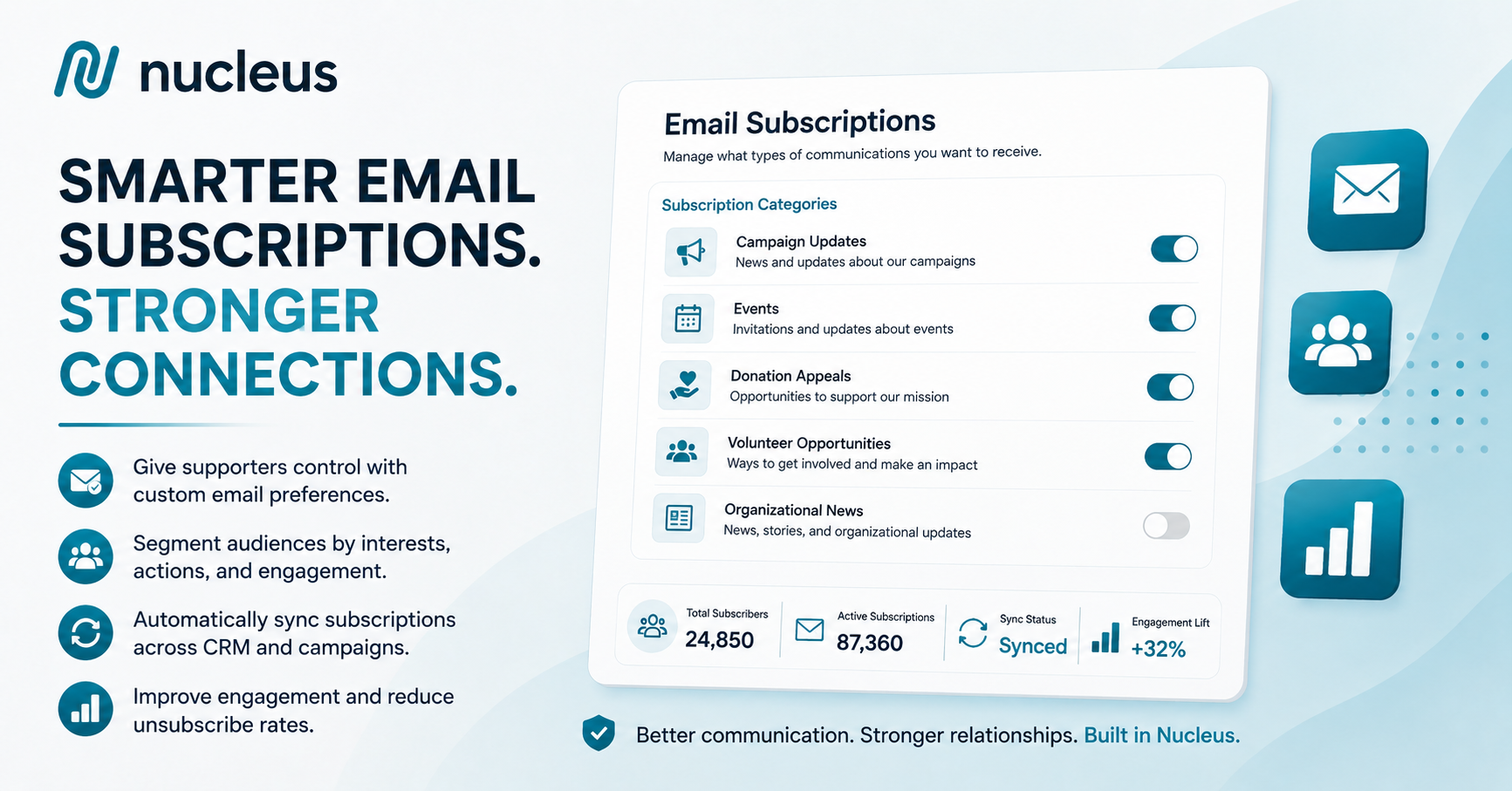
Built directly into the Nucleus platform, Email Subscriptions gives organizations a modern, flexible, and intelligent way to manage audience communication preferences while keeping everything fully connected to CRM records, segmentation tools, and the email builder.
Move Beyond One-Size-Fits-All Email Lists
Traditionally, many organizations have relied on a single large email list with limited subscriber control. This often leads to generic messaging, lower engagement, and higher unsubscribe rates.
With Nucleus Email Subscriptions, organizations can now create and manage multiple subscription types across:
• Campaign updates
• Events
• Memberships
• Donations
• Volunteer programs
• Website signups
• And more
This allows teams to organize audiences more strategically while delivering communication that feels more relevant and personalized to each supporter.
Smarter Segmentation and Better Campaign Performance
Nucleus Email Subscriptions helps organizations build stronger audience engagement strategies through smarter targeting and cleaner data management.
Teams can now:
• Build more targeted and personalized email campaigns
• Reduce unsubscribe rates by giving users more control
• Automatically enroll supporters into relevant communication categories
• Segment audiences based on interests, actions, engagement, and signup source
• Keep subscriber preferences synced across CRM, email, and audience tools in real time
• Improve campaign performance through more intelligent audience targeting
Because subscription preferences are directly tied into the broader Nucleus ecosystem, organizations gain better visibility into supporter engagement while eliminating disconnected workflows and manual workarounds.
A Better Experience for Supporters
For end users, Email Subscriptions creates a significantly better communication experience.
Instead of being forced into all-or-nothing email lists, supporters can now choose exactly what types of communications they want to receive. Whether someone only wants event updates, volunteer opportunities, donation campaigns, or organizational news, Nucleus gives them the flexibility to manage their preferences more easily.
This level of transparency and control helps organizations build stronger trust with their audiences while improving long-term engagement.
Fully Connected Across the Nucleus Ecosystem
One of the biggest advantages of Nucleus Email Subscriptions is that every subscription action is fully logged, synced, and connected directly to the broader platform ecosystem.
That means organizations no longer need disconnected third-party subscription tools or complicated manual processes to maintain accurate audience data.
Everything works together seamlessly across:
• CRM records
• Audience segmentation
• Email campaigns
• Website signups
• Automation workflows
• Supporter engagement tracking
The result is stronger operational efficiency, cleaner audience management, and more intelligent communication workflows at scale.
Building Stronger Relationships Through Smarter Communication
The launch of Nucleus Email Subscriptions represents a major step forward for campaigns, nonprofits, advocacy groups, and organizations looking to improve how they engage supporters.
By combining flexible subscription management with real-time CRM syncing and advanced segmentation capabilities, organizations can now deliver more relevant communication, strengthen supporter relationships, and build smarter engagement strategies directly within Nucleus.
Smarter audience management starts with giving both organizations and supporters more control — and Nucleus Email Subscriptions is designed to do exactly that.
Ready to ditch the one-size-fits-all email list?
Nucleus Email Subscriptions is live — smarter audience management starts today.
Emails
Engagement
Volunteers
No Strangers Here, Just Friends You Haven’t Met
April 10, 2025
If you walked up to a stranger on the street and asked them for $20, odds are they’re going to look at you like you're crazy and walk away. I cannot blame them; I’d do the same. Now… what if, instead, you engaged them in conversation, swapped contact information, developed a friendship over the course of many weeks, and THEN asked for $20? You might have a better shot.
Well, in some ways, email marketing is a lot similar. People are much more likely to support a cause that they are familiar with and trust. So, with that in mind, it might be time to consider how we can be building trust with our subscribers so that we see the most possible success with our emails.
This means that we need to provide content that makes the recipient feel valued as opposed to just another donor. Before we ask for money and support, we need to show the subscriber how much they matter to us; that we do not just care about their wallets.
So what kind of content can we send out that would align with this goal of building trust? I have a few ideas…
Newsletters and informational content
- These emails can be used to inform your recipients on your mission and the news you find most important. Subscribers will be able to see how their values align with your own and, in turn, may acquire more support for your cause.
Feedback
- Do not be afraid to ask your subscribers about their opinions. Whether you need advice on how to go about things or you’d like to know what you can do better in the future, your recipients should be the first people you ask. Their opinions matter most!
Prospecting
- Sometimes the easiest way we can appeal to our subscribers is to ask them what they care to hear about. Our Nucleus CRM allows us to quickly tag our recipients so we can be ensuring we are reaching out to them with their interests in mind.
These are just a few types of emails we can be sending to our subscribers to ensure that we are building trust before forcing asks down their throat. I think you’ll all find that embedding a little love and care into all of our emails will always pay off in the long run.
For more information regarding how to send less aggressive copy while yielding higher return, contact our team for training or insight and visit your Nucleus Resource Library!
OR
Start sending with Nucleus today | Click here!
Communication
Engagement
Texting
Messaging Mania: Why Now’s the Perfect Time to Send That Text!
September 26, 2024
As Election Day approaches, every moment counts, and staying connected with your supporters is more critical than ever. Are you using Nucleus Text or P2P Messaging to ensure that instant, personalized communication drives your campaign forward?
Imagine this: It's the night before the election, and you're able to instantly rally your base with a targeted message reminding them to vote. With Nucleus, that's not just possible—it's easy. Our Nucleus Text feature lets you send out quick, personalized updates, ensuring your supporters know where to go, what to bring, and why their vote matters.
For a more personal touch, our P2P Messaging tool allows you to engage in one-on-one conversations at scale. Think about the impact of a direct message from a volunteer, asking a voter if they need help getting to the polls or answering any last-minute questions. This kind of outreach can be the difference between a vote cast or a vote missed!
Beyond Election Day…
But it doesn't stop there. Nucleus messaging integrates seamlessly with your broader campaign efforts. If you're hosting a last-minute rally, use our messaging tools to send out an invite, then track who opens the message and who clicks to RSVP. Need to share crucial updates from the campaign trail? A quick text or P2P message ensures your supporters are always in the loop, no matter where they are.
And as your messages go out, you'll have real-time analytics at your fingertips. See how many people received your message, who engaged, and who might need a follow-up—all in one place, without missing a beat.
As you gear up for the final push, make sure you're equipped with the tools that can make the difference. Log in to your Nucleus account today and start using our messaging features, or reach out to our team for more personalized guidance.
Why Messaging?
Well, besides the fact that everyone has a phone attached to them these days, texts also benefit that other messaging like emails can't give you. Some advantages include:
Higher Open Rates: Text messages generally have much higher open rates compared to emails. Many people read texts almost immediately after receiving them.
Immediate Delivery: SMS messages are delivered instantly, making them ideal for time-sensitive information or urgent updates.
Personalization: Texts can feel more personal and direct, which can enhance engagement and make your messages feel more immediate and relevant.
Conciseness: Text messages force you to be brief and to the point, which can be effective for quick, clear communication.
Better Reach: Text messages can reach people who may not check their email frequently or who have limited internet access but always carry their phones.
Higher Engagement: Due to the personal nature of text messaging, recipients are more likely to respond or take action quickly.
No Spam Filters: Text messages don't get caught in spam filters like emails can, ensuring your message gets through.
Convenience: For quick updates or reminders, texts can be more convenient and accessible than email, especially on the go.
However, it's important to note that text campaigns also have limitations, such as character limits and potential costs per message. Balancing text and email campaigns can often be the best approach, leveraging each of their strengths.
Try these text campaign ideas!
- Voter Reminders
Send out last-minute reminders to your supporters about important voting deadlines, like early voting dates or Election Day itself. Include personalized information, such as polling locations or voting hours, based on their registered address.
- Event Invitations
Quickly notify your supporters about campaign events, rallies, or virtual town halls. Include a link to RSVP directly within the text, and follow up with a reminder on the day of the event.
- Get-Out-The-Vote (GOTV) Campaigns
Launch a text campaign to encourage voter turnout. Send personalized messages asking if they need a ride to the polls, reminding them to bring the necessary ID, or simply urging them to get out and vote.
- Fundraising Appeals
Use text messaging to send urgent fundraising appeals. A quick, compelling message with a direct link to donate can significantly boost contributions, especially during crucial campaign moments.
- Poll Watcher Coordination
Coordinate your poll watchers or volunteers with real-time updates and instructions. This is especially useful on Election Day, where rapid communication is essential.
- Issue Awareness
Educate your supporters on key issues and your stance on them. Short, informative texts can help clarify your position and mobilize your base on important topics.
- Thank You Messages
After an event, donation, or volunteer effort, send a quick thank-you text to show appreciation. Personalized gratitude can strengthen supporter loyalty and encourage future engagement.
- Surveys and Feedback
Engage your audience by sending out quick surveys or asking for feedback via text. Use this data to fine-tune your campaign strategy or understand voter concerns better.
- Crisis Communication
If there's an unexpected change in the campaign (like a venue change or emergency), a text message is the fastest way to reach your audience and keep them informed.
- Election Results Updates
Keep your supporters in the loop on Election Night with live updates as results come in. Share the excitement and keep them engaged as the outcome unfolds.
So what are you waiting for?
Now is the perfect time to send those texts and get your supporters more engaged than ever!
Nucleus user→ To get started today, contact your client services representative.
Or
Click here to join Nucleus!
Emails
Engagement
Why Didn’t Everyone Click My Email?
June 20, 2024
By Julia, Deliverability Expert
Life: through the perspective of an email.
If you have sent a mass email through a marketing platform, you’ve probably wondered why the standards for “good” recipient engagement are so low.
That’s because there is a lot more involved in the life cycle of an email than just receiving and opening emails.
To get a better idea of the entire journey of an email, let’s review the phases of life your email goes through after you hit send…
First, we have the matter of deliverability. Domains and IPs that are blocked by a server will not deliver to that server, no matter the circumstances (referred to as hard blocks). It’s important to note that there can also be many temporary issues with deliverability (known as soft fails), that can randomly affect any email.
From there, we will encounter difficulties with inbox placement. Not every email will land in a recipient’s inbox; some will find their way into spam & promotional mailboxes, which are rarely checked by recipients.
Lastly, & seemingly most important, is the overall recipient engagement. This is, by far, the most broad phase of life as it is affected by so many factors. Should your email make it to the recipient’s inbox, there are countless elements that will determine whether or not & how the user engages with your email. For instance, your user may love your subject line & hate your content; they may hate your subject line so they never open to see your content, they may never check their inbox & didn’t even see your email, & numerous other scenarios that lead to more or less engagement in an email.
The majority of emails sent will actually never be seen by anyone & that’s just how the game of email marketing goes. BUT, for this reason, you should be proud to see a 15% open rate with a 2.5% click rate – those numbers are actually a lot better than you think!
For more resources, Nucleus users can visit the resource library!
or