Not on day one
When a team switches email platforms, one question tends to show up late in the process: "How soon can we send to our whole list?"
Not on day one. If a platform promises you otherwise, be careful.
A new platform means new sending infrastructure, and Gmail, Outlook, and Yahoo have never seen it before. They won't deliver your mail at scale until they have evidence that you're a sender people want to hear from. You build that evidence through warm-up, and it does more than anything else to decide whether your deliverability holds after a switch or falls off.
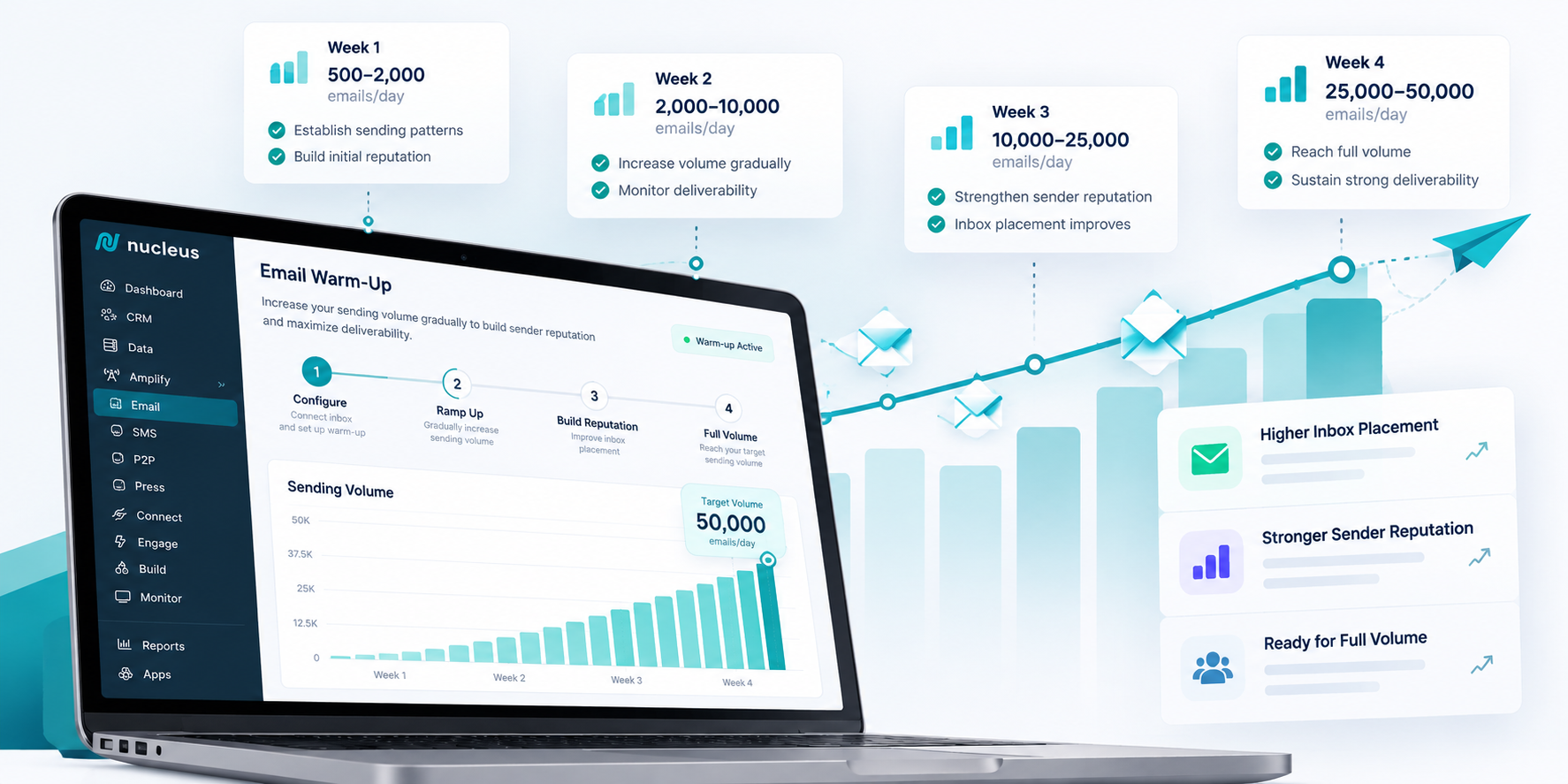
Plan on 4 to 6 weeks from first send to full volume. List size, target volume, and audience engagement all move that number.
What warm-up is
You start by sending small volumes from the new setup and raise them in steps, so mailbox providers get to know you before you send at full scale.
Reputation is judged mostly at the domain level now, based on your authentication setup, complaint rates, and sending history, rather than the IP address you send from.
A domain with no recent sending history is an unknown. When an unknown sender suddenly pushes out a huge volume, it looks like a spammer, even if the content is good and the list is clean. Warm-up gives providers a track record to look at: people open the mail, few addresses bounce, and almost nobody complains. That record is what gets you into the inbox at scale.
Two things to finish before warm-up starts
- Domain authentication. Add SPF, DKIM, and DMARC records to your domain's DNS. SPF lists the services allowed to send for you, DKIM signs each message so providers can confirm it came from you, and DMARC tells providers what to do with mail that fails those checks. The major providers require all three for bulk senders.
- List hygiene. Remove duplicates, suppress unsubscribes and past bounces, and flag invalid addresses. Warming up with a dirty list sends providers exactly the wrong signals.
Our team sets up both with you before your first send. Once we have DNS access and your list, it takes 1 to 2 business days.
Phase 1: Start with your most engaged contacts
DAYS 0 TO 5
The first sends go only to people likely to engage, usually anyone who opened or clicked in roughly the last 30 to 90 days. Opens, clicks, and replies this early are the strongest positive signals you can give a mailbox provider, and they set the baseline for everything that follows.
Volumes stay small on purpose. Day one is usually a few hundred emails, scaled to the size of your list.
Phase 2: Ramp up volume gradually
DAYS 5 TO 26 (ABOUT 3 WEEKS)
Once the early sends look good, volume goes up on a schedule. A common pattern is to roughly double every few sends, as long as the numbers stay healthy. The calendar is a guide, not a promise. The ramp moves forward when the signals are good and pauses when they aren't.
What we watch during this phase:
- Bounce rate: under 2%
- Spam complaint rate: under 0.3%, which is Google's published limit for bulk senders, and ideally under 0.1%
- Engagement: opens and clicks compared with your historical baseline
- Inbox placement signals, tracked through authentication reports and engagement data
If a metric slips, we hold volume where it is or step back for a few sends. A short pause costs you days. Pushing through a warning sign can cost you weeks.
Phase 3: Bring in less engaged segments
DAYS 26 TO 40 (ABOUT 2 WEEKS)
After your reputation is established with engaged contacts, we start adding segments that open less often. These contacts are more likely to bounce, ignore your mail, or mark it as spam. Bringing them in after trust is built lets your reputation absorb that risk.
This is also when we decide what to do with long-inactive contacts. Usually that means a re-engagement campaign or removing them. A slightly smaller list that people read will outperform a bigger one that mailbox providers treat as unwanted.
Phase 4: Full volume and steady state
AROUND WEEK 5 OR 6 AFTER FIRST SEND
Warm-up is done when your whole list is getting mail at normal volume and the metrics are stable. Reputation still needs upkeep after that. A sudden spike, like a holiday push at several times your usual volume, can still trip filters, so give those sends a ramp of their own.
Ongoing support from Nucleus. We keep monitoring bounce, complaint, and engagement trends, and your account team checks in regularly so we catch drift before it turns into a problem.
Shared vs. dedicated IPs
Your domain's authenticated identity carries more weight with inbox providers than which IP you send from, but the choice still shapes your setup:
- Shared IP. Your mail goes out from servers other senders use too, and those servers usually already have a track record. Your domain still needs its own warm-up regardless, since domain reputation doesn't carry over from the shared infrastructure.
- Dedicated IP. Servers used only by you, so you control that layer of reputation. It starts from zero and needs its own warm-up. We typically recommend it for very high-volume senders who want that control.
We determine your setup during onboarding, based on your volume.
Can we still send? And why rushing backfires
Yes, you can still send. Your most engaged audience gets email from phase 1 on, and only full volume to your full list has to wait. Many teams keep their previous platform running for the rest of the list during the transition so nobody goes without email. We help plan that overlap so the two platforms don't both send to the same contacts.
Rushing doesn't save time. It moves the delay to a worse moment. Sending too much too soon can get your mail throttled or delayed, push your best emails into spam (even for loyal subscribers), or get your sends blocked outright, which takes weeks of careful work to undo. A few extra weeks of warm-up up front costs far less than a damaged reputation in the middle of a campaign that matters.
Cold outreach warm-up looks different
Everything above assumes your list has emailed with you before, even from a different platform. Cold outreach starts from zero: the contacts have never heard from your domain, so warm-up has to build trust without that head start.
- A dedicated sending domain. Cold programs run from a subdomain or a separate domain built only for outbound, never your primary domain. If deliverability takes a hit, it stays contained instead of reaching your billing or product mail.
- A slower ramp. Cold warm-up typically starts around 5 emails per mailbox on day one and works up to 25 to 40 a day by around day 28, well below the Phase 2 volumes above, because there's no engagement history to lean on yet.
- Several mailboxes, not one. Running 3 to 5 mailboxes per domain spreads the load and keeps any single inbox inside a range providers treat as normal, commonly cited as 30 to 50 sends a day once an inbox is warmed. Pushing much past 100 a day per mailbox is what tends to trip filters.
- A higher bar on quality. Every bounce or complaint carries more weight against a domain with no track record, so verify addresses before the first send and write for a specific reader instead of a mail merge.
COLD EMAIL RAMP-UP PLAN (PER MAILBOX)
| WEEK |
VOLUME PER MAILBOX/DAY |
CONTACTS |
WATCH |
| 1 (Days 1 to 7) |
5 to 15 |
Best-fit prospects, verified and hand-checked |
Replies and bounces, not opens |
| 2 (Days 8 to 14) |
15 to 25 |
Same tight segment, expanded slightly |
Bounce rate under 2% |
| 3 (Days 15 to 21) |
25 to 35 |
Broader ICP segments added |
Spam complaints under 0.3% |
| 4 (Days 22 to 28) |
35 to 40 |
Full target segment |
Reply rate holding steady |
| 5+ (steady state) |
30 to 50 |
Full target segment, ongoing |
All of the above, monitored weekly |
Per-mailbox limits, not per-domain. With 3 to 5 mailboxes running in parallel, a domain can reach roughly 90 to 250 sends a day by week 4 without any single inbox looking overworked. Hold volume flat, or drop back a step, whenever bounce or complaint rates move past the thresholds above; push forward only when they hold.
Cold email carries its own compliance rules. CAN-SPAM requires a working opt-out honored within 10 business days, clear identification of who's sending, and no misleading subject lines. Treat any reply asking to stop as an opt-out, even without a formal unsubscribe click.
We set up dedicated sending domains and mailbox rotation as part of onboarding for cold programs, and build the ramp around your target volume rather than an existing list's engagement.
Let's build your warm-up plan
Every warm-up depends on your list size, how engaged your audience is, and how much you plan to send, so the best way to set expectations is to plan it together. Talk to our team and we'll put together a warm-up and scaling plan for your list, with clear milestones, before you sign anything.
Warming up with Nucleus
| PHASE |
WHAT HAPPENS |
WHAT WE MONITOR |
DURATION |
| 0. Prerequisites |
Domain authentication (SPF, DKIM, DMARC) and list cleanup |
Records verified, suppressions in place |
1 to 2 business days |
| 1. Engaged-first sends |
Small sends to contacts who recently opened or clicked |
Opens, clicks, bounces |
Days 0 to 5 |
| 2. Gradual ramp |
Volume roughly doubles every few sends while metrics stay healthy |
Bounces (<2%), spam complaints (<0.3%, ideally <0.1%), domain and engagement signals |
About 3 weeks |
| 3. Expand segments |
Less engaged contacts added once trust is established; inactive contacts re-engaged or removed |
Engagement by segment, complaints |
About 2 weeks |
| 4. Full volume |
Full list at normal volume, with ongoing monitoring |
Reputation stays steady |
From about week 5 or 6 |
WORTH KNOWING
- You aren't dark during warm-up. Engaged contacts get email from day one.
- The ramp follows your metrics, not the calendar. We pause if signals slip, which protects inbox placement.
- Domain reputation matters more than the IP you send from.
- Cold outreach needs its own, slower ramp and a dedicated sending domain, since there's no engagement history to build on.
- Rushing backfires. A reputation damaged by sending too fast can take weeks to repair.